Left · the labs.llc tool
Sensor, side by side
Six instruments in a browser tab, against two phone physics labs and a government sound-level meter.
Right · set against
- phyphox
A free smartphone physics lab from RWTH Aachen University, with data export and browser remote control.
page checked 2026-09-27 20:04 UTC - Physics Toolbox Sensor Suite
An Android and iOS app reading motion, light, sound, magnetic-field and pressure sensors.
page checked 2026-09-27 20:04 UTC - NIOSH Sound Level Meter
A free iOS sound-level meter from the US National Institute for Occupational Safety and Health.
page checked 2026-09-27 20:05 UTC
1 · The tool
What it is, and who it is for
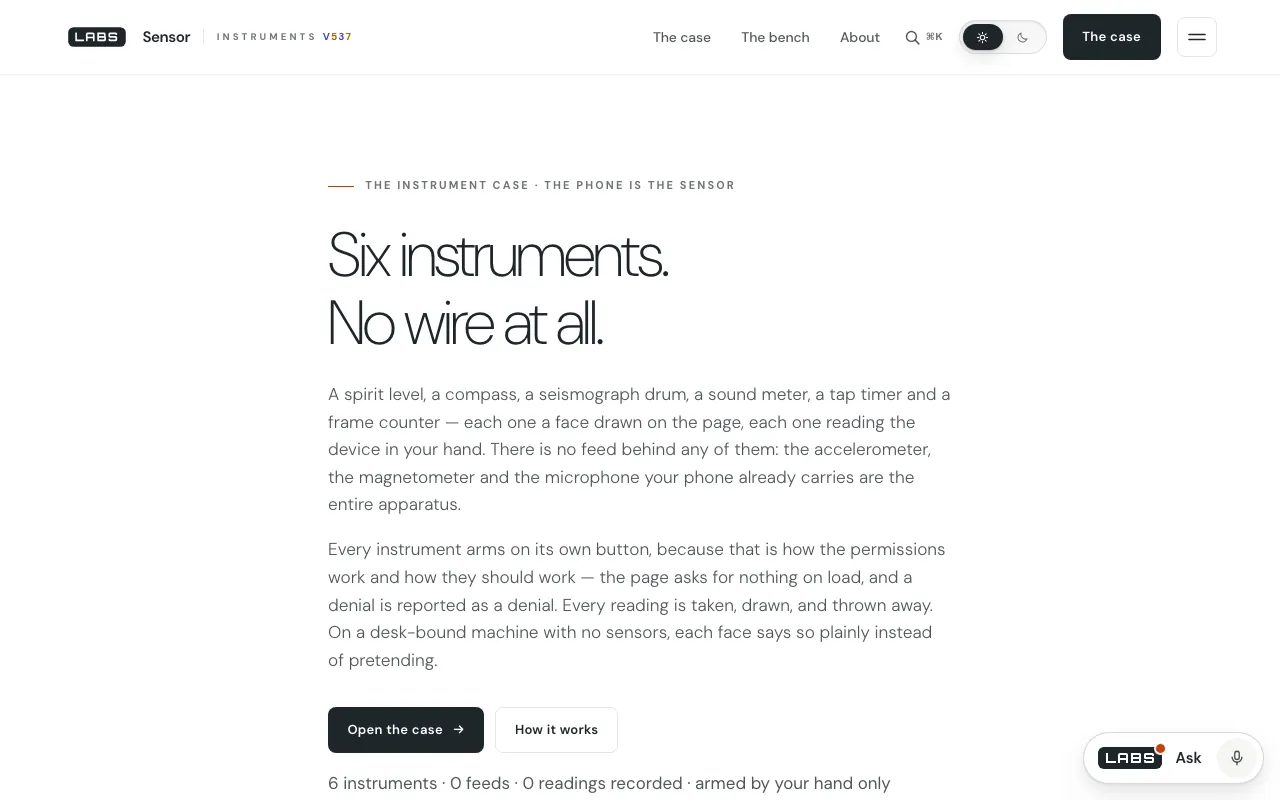
Phones and laptops carry sensors most people never read. Sensor on labs.llc turns them into six instruments in a browser tab: a spirit level, a compass, a seismograph drum, a sound meter, a tap-tempo timer and a frame counter. Its attention goes into the labelling: each instrument says how far its reading can be trusted.
It suits anyone who wants a quick level, bearing or loudness check without installing an app, and teachers and curious people who want to see what the device can sense.
2 · The workings
How it works
Everything runs in the browser with nothing upstream (sensor/assets/js/app.js lines 1-4). The level and compass read DeviceOrientation, the drum reads DeviceMotion, the meter runs the microphone into an AnalyserNode, and the timer and frame counter use the page's own clock. Permission is asked only from each instrument's own button, never on load. Readings are drawn and thrown away; the only stored item is which instruments you switched on, and every loop stops when the tab is hidden.
- the device's orientation and motion sensors
- the device microphone
- the page's own clock
Where the work happens: Your browser, aloneNo server and no feed; the instrument code makes no network requests.
3 · The test
What we ran, and what came back
Run against a local copy of labs.llc build 537, byte-identical to the live site. Times are UTC.
| What we did | When (UTC) | What came back |
|---|---|---|
| The page | 2026-09-27 20:00:31 | HTTP 200, 59,929 bytes. |
| Network calls in the instrument code | 2026-09-27 20:00:31 | No fetch, XMLHttpRequest or sendBeacon in app.js. The page does load the site-wide Google Analytics tag, which measures the page, not the sensors. |
| Live readings | not measured | They need a real device and a tap to grant permission, which a command-line test cannot give. We report no readings. |
4 · Side by side
Row by row against phyphox, Physics Toolbox Sensor Suite, NIOSH Sound Level Meter
2 to labs.llc3 elsewhere1 level
01Getting started
Open a tab. Each instrument asks for its sensor only when you press its button.
Evidence: app.js lines 7-9, 89-90phyphox and Physics Toolbox are apps for iOS and Android.
NIOSH SLM is an iOS app, free to download.
labs.llc needs no install and works on a borrowed device; the others need the app store.
02How many sensors
Orientation, motion and the microphone, plus two clock-based tools: a tap-tempo timer and a frame counter.
Evidence: app.js lines 1-4Physics Toolbox reads motion, light, sound, magnetic field and ambient pressure, and adds tone and colour generators and a stroboscope.
Apps can reach sensors a browser cannot; Physics Toolbox covers more.
03Recording and export
Nothing is recorded or exported. No log, no CSV.
Evidence: app.js lines 11-14phyphox exports data in many common formats, runs user-made experiments, and can be controlled from any web browser.
For a lab exercise that needs numbers afterwards, phyphox is the instrument.
04A sound level you could stand behind
Relative dBFS, labelled “uncalibrated, relative”, with echo cancellation, noise suppression and automatic gain switched off. The page calls it useful for “louder than a moment ago” and useless in a lawsuit.
Evidence: app.js lines 354-355, 382, 425; index.html line 669NIOSH SLM is accurate to ±2 dBA, tested in a reverberant chamber, with noise dose, LAeq, TWA and A, C and Z weighting.
NIOSH's app measures; the labs.llc meter compares. labs.llc says so plainly, which is to its credit.
05Knowing how far to trust a reading
The compass says “magnetic north” only when the device gives an absolute heading and “uncalibrated” otherwise. A refused permission or missing sensor is shown as such, never as a zero.
Evidence: app.js lines 10-11, 180-181, 230-238NIOSH SLM states its accuracy and how it was tested, for its one instrument.
labs.llc labels the trust of all six instruments; NIOSH does so thoroughly for one.
06What leaves the device
Nothing from the instruments: readings are drawn and discarded.
Evidence: grep of app.js, 20:00:31 UTCphyphox offers remote control and download from a computer's browser, which means keeping the data, as a lab should.
Two honest designs: labs.llc keeps nothing, phyphox keeps what an experiment needs.
5 · The shortcomings
Where it falls short
- The sound meter reads uncalibrated dBFS, so no dBA figure and no noise dose.
- Nothing can be recorded or exported.
- It depends on what the browser exposes: a desktop without motion sensors gets only the meter, timer and frame counter, and iOS needs a tap per instrument.
- We could not take live readings in this review.
6 · The verdict
Which side, for which job
Left: labs.llc Sensor
Pick Sensor on labs.llc when you need a level, a bearing or a rough loudness comparison now, on any device, with nothing installed and nothing kept.
Right: elsewhere
Pick phyphox or Physics Toolbox when you need data afterwards, and the NIOSH app when a sound level has to mean something.
The quickest way to borrow your device's sensors, and admirably honest about their limits. Not a measuring instrument, and it does not pretend to be.
Try Sensor on labs.llc