Left · the labs.llc tool
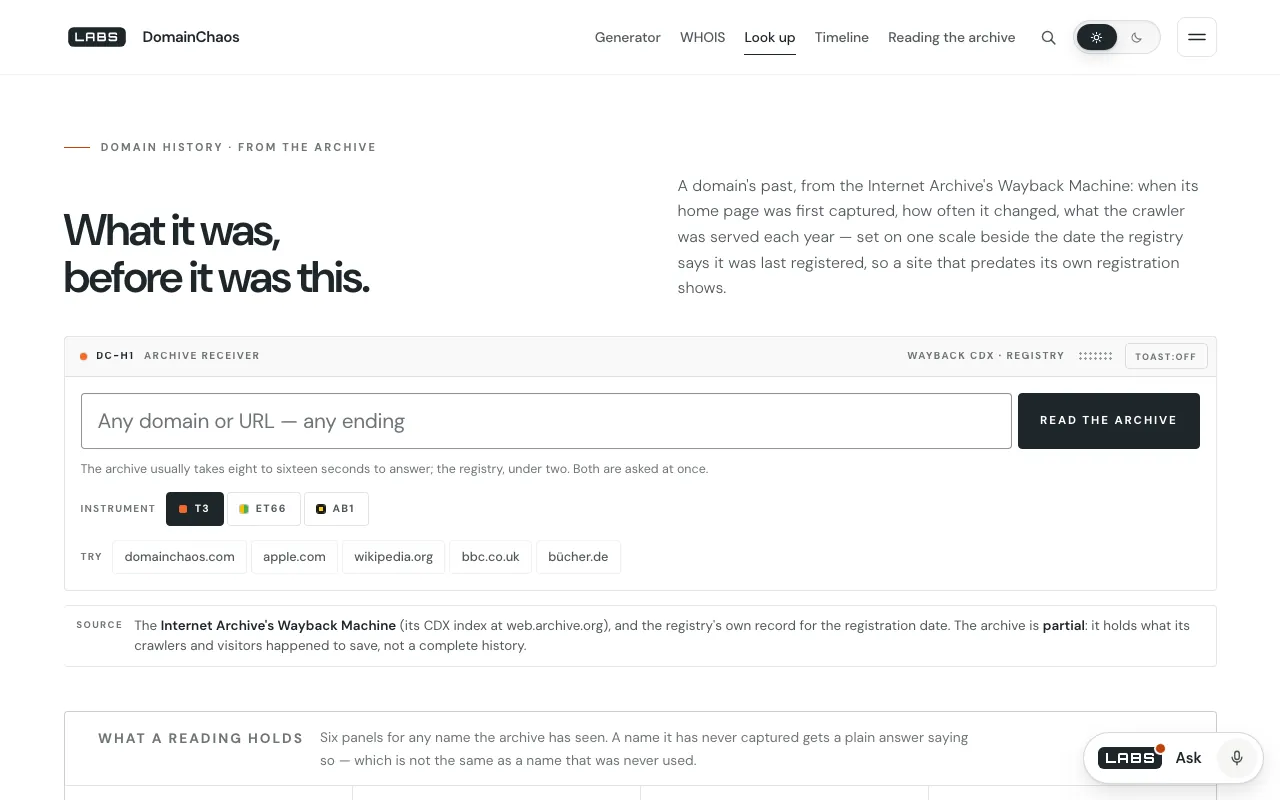
Domain history, side by side
What a name was before it was this: the labs.llc history desk against the Wayback Machine and two WHOIS history services.
Right · set against
- Wayback Machine
The Internet Archive itself: a calendar of captures, Save Page Now, and a view comparing two captures.
page checked 2026-09-27 20:03 UTC - DomainTools WHOIS History
Past WHOIS records for a domain on a timeline, with change views and a text filter.
page checked 2026-09-27 20:03 UTC - WhoisXML API WHOIS History
Historical WHOIS records through a web lookup, an API and database downloads.
page checked 2026-09-27 20:03 UTC
1 · The tool
What it is, and who it is for
Before paying for a domain it is worth knowing whether it had a previous life. The labs.llc history desk answers from the public record: it reads the Internet Archive's captures of the name, counts the points where the archived content changed, and puts the registry's creation date on the same scale, so a website older than its own registration stands out.
It is aimed at buyers, researchers, brand and SEO people, and anyone curious about what used to live at an address.
2 · The workings
How it works
Two questions leave the browser at once (dc-history.js lines 1-19): one to the site's relay, tools.php?op=history, which reads the Wayback Machine's monthly capture counts and its CDX change index on the server, and one to the site's WHOIS engine for the registration date. The change index is slow on busy names, so the relay asks for the earliest 1,500 change points and the last two years' 500 separately, and marks the years between as not covered rather than guessing. It also holds itself to ten requests a minute to the Internet Archive across the whole site.
- web.archive.org/__wb/sparkline: capture counts per month
- web.archive.org/cdx/search/cdx with collapse=digest: content-change points
- the registry's RDAP or WHOIS, via the site's WHOIS engine: creation date
Where the work happens: A server relay plus the browserThe relay reads the archive; the browser asks the WHOIS engine and draws both on one scale.
3 · The test
What we ran, and what came back
Run against a local copy of labs.llc build 537, byte-identical to the live site. Times are UTC.
| What we did | When (UTC) | What came back |
|---|---|---|
| History of wikipedia.org | 2026-09-27 19:58:49 | HTTP 200 after 30.6 s. Capture counts came back in 556 ms: first capture 2001-07-27, 422,350 captures over 26 years. Both change queries hit the 30-second timeout, so no change points; the answer said so and suggested trying again. |
| History of iana.org | 2026-09-27 20:07:02 | HTTP 200 after 30.5 s. First capture 1997-12-10, 11,192 captures over 30 years. The recent change query answered in 7.6 s with 294 content changes, complete from 2026-03-23 to 2026-09-25; the early one timed out. |
4 · Side by side
Row by row against Wayback Machine, DomainTools WHOIS History, WhoisXML API WHOIS History
2 to labs.llc3 elsewhere1 level
01Seeing the old pages
It counts captures and changes and links each change point to the Wayback Machine; it does not show or compare the pages itself.
Wayback Machine shows the archived pages and, through its Changes view, sets two captures side by side with additions and deletions highlighted.
The archive is the place to look at what a site said. labs.llc is a summary of it.
02Registration and archive on one timeline
Captures per year as a band, content changes as ticks, the registration date as a needle. Captures older than the registration are named as “a previous owner, or a lapse”, and the page never pretends to know which.
Evidence: dc-history.js lines 4-13 and 224Wayback Machine is the archive, with a calendar of captures per URL.
DomainTools shows past WHOIS records on a timeline, per its documentation.
labs.llc joins the two authorities in one picture; each comparator, on the pages we read, holds one of them.
03How often the site changed
Collapsing the CDX index by content digest gives every point where the archived page changed. For iana.org: 294 changes in six months, with the coverage dates stated.
Evidence: tools_history.php lines 11-17; iana.org testWayback Machine compares any two captures you choose in detail.
labs.llc answers how often; the Wayback Machine answers what exactly. Different questions, both useful.
04Who owned it before
Not covered. The desk shows what the archive holds, not past registration records.
DomainTools shows historical WHOIS records with side-by-side and in-line change views and a text filter; search results describe it as for subscription members.
WhoisXML API claims 28.7 billion+ WHOIS records, often back to 2010; its web lookup shows the last three.
For past owners, the two history services are the tools; labs.llc has nothing here.
05Price of a first look
Free, with no account, key or credits: 26 years of monthly counts for wikipedia.org, no sign-in.
Evidence: test at 19:58:49 UTC; no account path in dc-history.jsWhoisXML API gives 500 free API credits on sign-up.
labs.llc asks for nothing; the history services ask for a subscription or credits for anything deep.
06Adding to the record
Read-only: it cannot save a page into the archive.
Wayback Machine offers Save Page Now; its help pages say captures can take three to ten hours to appear.
Only the archive can add to the archive.
5 · The shortcomings
Where it falls short
- No past ownership: it cannot tell you who held the name before.
- Slow and sometimes empty-handed on heavily archived names: both tests took about 30 seconds, and wikipedia.org came back with no change points at all.
- It links out to the Wayback Machine for the pages themselves rather than showing or comparing captures.
6 · The verdict
Which side, for which job
Left: labs.llc Domain history
Pick the labs.llc desk for a free first look at a name's past: how long it has been on the web, when its content moved, and whether it was live before its current registration.
Right: elsewhere
Pick the Wayback Machine to read the old pages, and DomainTools or WhoisXML API when you need to know who owned the name.
A careful first look that joins two authorities and marks its own gaps; slow on famous names and silent on past owners.
Try Domain history on labs.llc